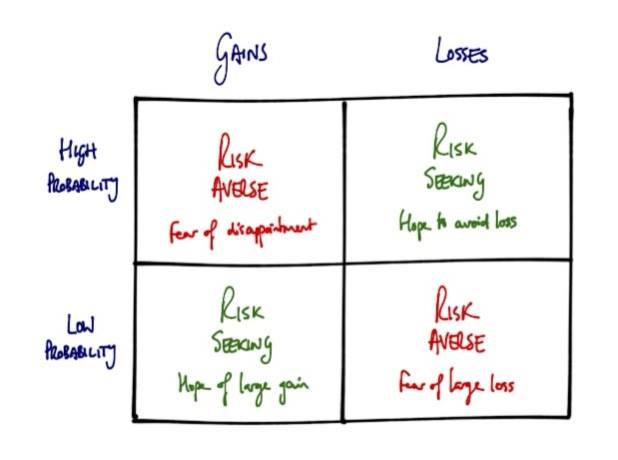
One of the controversial theories in real estate investing is called the ‘Prospect Theory’ or the ‘Loss-Aversion Theory’
Prospect theory states that ‘people’s perceptions of gain and loss are skewed.’ That is, people are more afraid of a loss than they are encouraged by a gain. If people are given a choice of two different prospects, they will pick the one that they think has less chance of ending in a loss, rather than the one that offers the most gains.
Example: if you offer a person two investments, one that has returned 5% each year and one that has returned 12%, lost 2.5%, and returned 6% in the same years, the person will pick the 5% investment because he puts an irrational amount of importance on the single loss, while ignoring the gains that are of a greater magnitude. In the above example, both alternatives produce the net total return after three years.
Implication: Prospect theory is important for financial professionals and investors. Although the risk/reward trade-off gives a clear picture of the risk amount an investor must take on to achieve the desired returns, prospect theory tells us that very few people understand emotionally what they realize intellectually. For financial professionals, the challenge is in suiting a portfolio to the client’s risk profile, rather than reward desires. For the investor, the challenge is to overcome the disappointing predictions of prospect theory and become brave enough to get the returns you want.
Andrew Beattie, Investopedia